
The issue of faculty strength and qualification in Government Colleges under the Higher & Technical Education Department has been a persistent administrative and academic concern. The problem is multidimensional: vacant sanctioned posts, prolonged engagement of unqualified part-time faculty, irregular regularization practices, and evolving regulatory standards under NEP 2020, UGC Regulations, MZU Ordinance, and AICTE norms.
Over time, the cumulative effect of these factors has materially affected academic delivery, institutional compliance, and programme credibility—particularly in professional and semi-professional programmes such as BCA, BBA, and Geography under the Four-Year Undergraduate Programme (FYUGP).
The Joint Meeting of 29.07.2024: Recognition of a Systemic Problem
A decisive administrative moment occurred during the Joint Meeting of the Higher & Technical Education Department, DP&AR, and Finance Department held on 29 July 2024. The Minutes of the meeting explicitly recorded the Department’s concern over the phasing out of unqualified part-time Assistant Professors and the broader shortage of teaching faculty Minutes 29.7.2024 Minister, HTE.
The meeting acknowledged:
- The extension of 30 unqualified Part-Time Assistant Professors for the final period (01.03.2024–28.02.2025).
- The financial and staffing implications of phasing out both unqualified part-time and casual teaching faculty.
- The urgent necessity to fill vacant Assistant Professor posts to avoid institutional crisis.
Most significantly, the meeting approved the creation of new Assistant Professor posts to meet two essential objectives:
- Implementation of NEP 2020 (FYUGP expansion of teaching load).
- Compliance with minimum faculty staffing patterns stipulated by MZU Ordinance.
For the Department of BCA, the following new posts were approved:
- Govt. Champhai College – 4 posts
- Govt. Kolasib College – 4 posts
- Govt. Serchhip College – 1 post
Additionally:
- BBA (Govt. J. Thankima College) – 5 posts
- Geography (Govt. J. Thankima College – 5; Govt. Mamit College – 5)
The decision clearly recognized that staffing deficiencies were structural and could not be sustained under regulatory scrutiny.
Discontinuance of Unqualified Part-Time Faculty (09.02.2026)
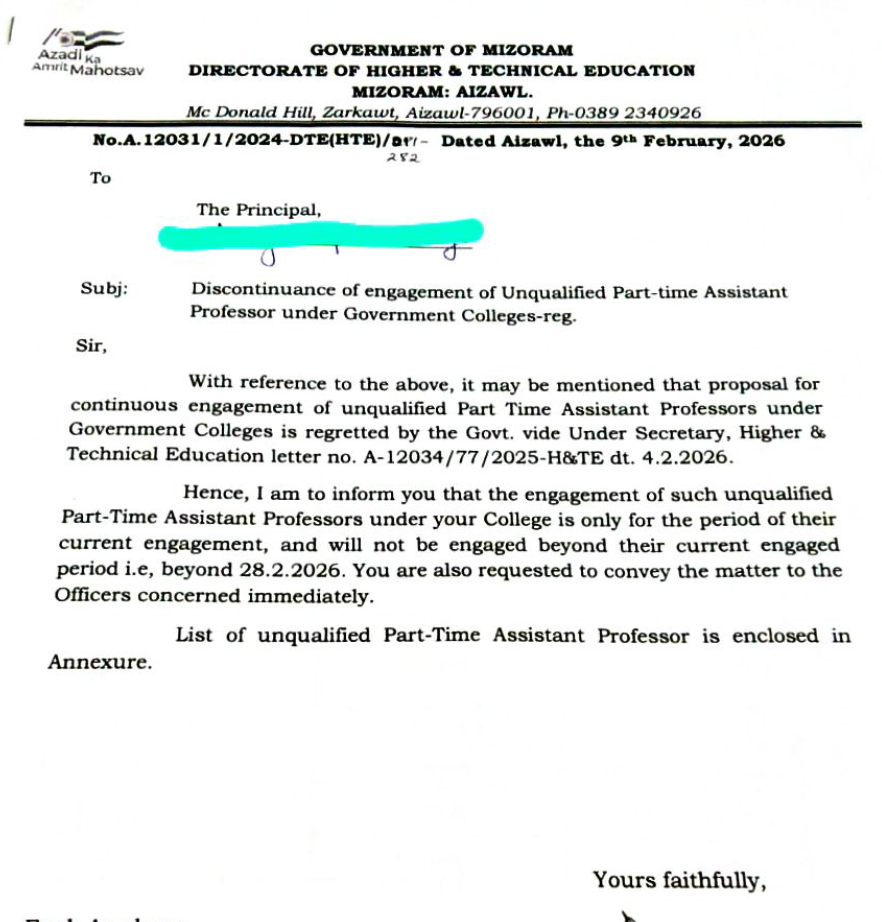
On 9 February 2026, the Directorate of Higher & Technical Education issued a notification directing the discontinuance of engagement of unqualified Part-Time Assistant Professors beyond 28.02.2026 unqualified.
This directive followed earlier communications that had already declared the extension from 03.03.2024 to 28.02.2025 as the “final” extension. Nevertheless, the services were further continued on humanitarian grounds up to 28.02.2026.
The 2026 notification thus marked the formal administrative acknowledgment that engagement of unqualified faculty could no longer continue.
This step aligns with:
- UGC minimum qualification requirements,
- AICTE norms for professional programmes,
- MZU Ordinance on faculty staffing patterns,
- NEP 2020’s emphasis on academic quality.
However, the discontinuance also highlighted the scale of prior deviation from regulatory standards.
Historical Recruitment Irregularities in BCA
The Department of BCA provides a case study of how prolonged deviations from qualification norms can accumulate into systemic weakness.
Advertisement No. 6 of 2007–2008 (MPSC)
The Mizoram Public Service Commission conducted direct recruitment for Lecturer (now Assistant Professor) in 2007. The advertisement prescribed:
- Master’s Degree in relevant subject with at least 55%
- Qualification in NET or equivalent accredited test
However, subsequent official communications (2009) indicated that selected candidates did not possess the prescribed Master’s Degree or NET/SET qualification at the time of appointment. Both were Bachelor’s degree holders.
Although one of these faculty members later obtained higher qualifications (including Ph.D.), the other continues in regular service without acquiring even the minimum essential qualification.
This created an early precedent where statutory eligibility criteria were effectively bypassed.
Regularization of Unqualified Faculty
Following the 2007 recruitment, several faculty members were initially engaged as:
- Part-Time Assistant Professors (without UGC minimum qualifications),
- Later promoted to Contract Assistant Professors,
- Eventually regularized.
In certain cases, even when part-time advertisements explicitly required Master’s Degree with 55% and NET/SLET/SET, selected candidates did not possess NET qualification.
Further, through a one-time relaxation order (2019), contract faculty were promoted to regular posts despite not fully meeting UGC standards.
This pattern reflects:
- Administrative accommodation over merit-based recruitment,
- Relaxation of eligibility norms,
- Progressive institutionalization of sub-minimum standards.
AICTE and Regulatory Implications
The Department of BCA falls within the regulatory purview of AICTE.
AICTE norms require:
- Prescribed minimum qualifications,
- Adequate number of regular faculty,
- Defined faculty–student ratio,
- Institutional academic governance standards.
Programmes lacking qualified and regular faculty risk:
- Non-renewal of approval,
- Restriction of intake,
- Academic credibility loss.
At present, certain colleges—particularly Govt. Champhai College and Govt. Kolasib College—have faced prolonged periods without adequate regular and fully qualified faculty in BCA. This places the programme’s regulatory compliance in a vulnerable position.
Impact on Academic Standards
The prolonged engagement of unqualified faculty has had measurable academic consequences:
- Dilution of Teaching Quality
Without Master’s degree-level subject mastery and research exposure, academic depth suffers. Professional programmes like BCA require continuous updating in computing, algorithms, software engineering, and emerging technologies. - Weak Research Culture
Faculty without NET/Ph.D. qualifications often lack exposure to research methodology, peer-reviewed publication, and academic project supervision. This undermines academic progression and student mentorship. - Assessment Standards
Faculty qualification correlates strongly with examination design, evaluation rigor, and moderation practices. Compromised qualifications often result in reduced academic benchmarking. - Student Competitiveness
Graduates entering higher studies or competitive employment environments face disadvantages if foundational academic delivery is sub-standard. - Institutional Reputation
Persistent deviation from qualification norms erodes public trust in Government Colleges.
Over more than 15 years, multiple opportunities were available for faculty to upgrade qualifications. Continued inability to meet minimum standards despite prolonged service indicates structural academic limitations.
Availability of Qualified Candidates
Recent recruitment exercises in other departments have demonstrated a strong pool of:
- NET-qualified candidates,
- SET-qualified candidates,
- Ph.D. holders,
- Candidates meeting full UGC norms.
The Department of BCA similarly has a substantial number of eligible candidates awaiting fair recruitment opportunity.
The supply-side constraint is no longer candidate availability—it is procedural activation of transparent recruitment.
The Present Opportunity
The creation of 9 new BCA posts provides a structural opportunity to:
- Correct historical irregularities,
- Restore regulatory compliance,
- Strengthen academic standards,
- Ensure merit-based recruitment,
- Align with NEP 2020 goals.
If these posts are filled strictly through open advertisement and transparent selection adhering to UGC and AICTE norms, it can reset the academic trajectory of the programme.
Conversely, repetition of prior relaxation practices would institutionalize sub-standard recruitment permanently.
Conclusion
The faculty crisis in Government Colleges is not merely about vacancy numbers—it is about qualification integrity, regulatory compliance, and academic credibility.
The sequence of events—from the 2007 recruitment irregularities, prolonged part-time engagement without qualifications, multiple relaxations, and eventual discontinuance order in 2026—demonstrates that administrative accommodation has already compromised academic standards.
The academic standard has been materially weakened over the past decade and a half due to sustained engagement of unqualified faculty. The evidence indicates that prolonged deviation from prescribed norms has diluted teaching quality, research engagement, and regulatory compliance.
The decisions recorded in July 2024 acknowledge the structural problem. The discontinuance directive of February 2026 signals a corrective direction.